
How swastika from ancient Georgia taught me something about Ukraine
Swastika is an equilateral cross with four arms bent at right angles. This sigh is usually associated with World War 2 and the Nazi regime in Germany. At least in Europe and the North America.
I knew that this sign is widely used in India and Eastern cultures and symbolizes sun. I was quite surprised to see swastika on ancient Colchis jewerlery in the Georgian National Museum in Tbilisi. These golden tubes bearing swastikas were used for decorating hair and date back to 1-4AD.
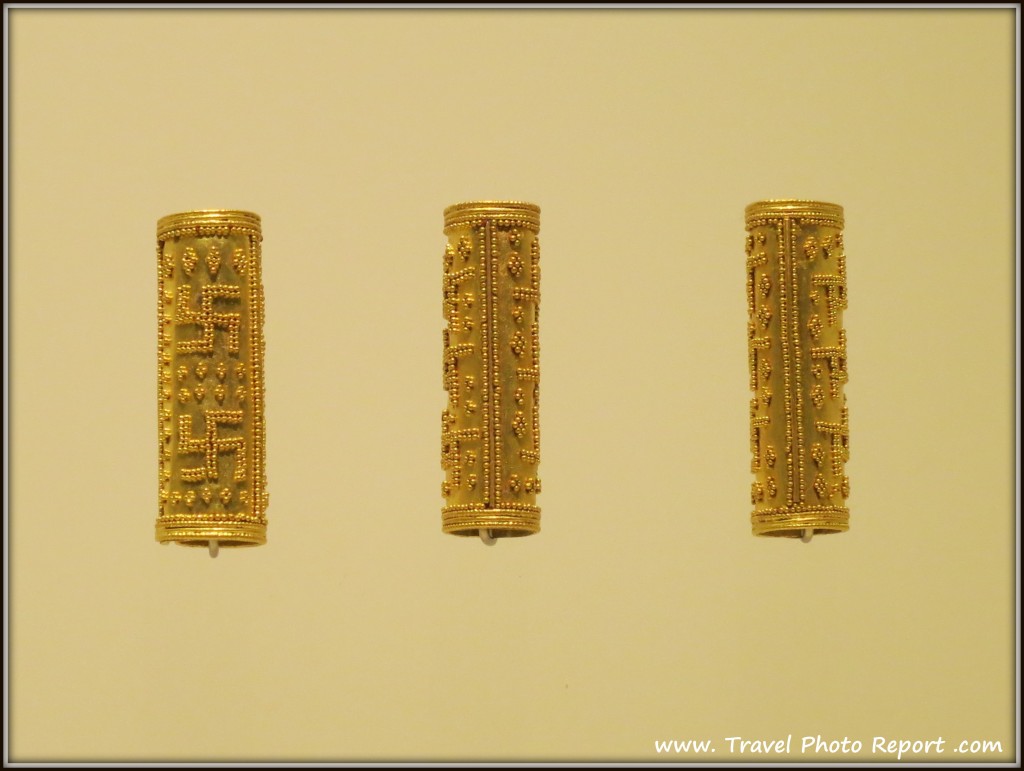
I decided to read more on this subject on Wikipedia:
The swastika is recognized as a Hindu symbol in most parts of the world. In Hinduism, the swastika is at times in certain sects considered a symbolic representation of Ganesha. In Hindu rites, Ganesha is offered first offerings in every pooja. The swastika is made with Sindoor during Hindu religious rites.
In Bronze Age Europe, the “Sun cross” (a three- or four-armed hooked cross in a circle) appears frequently, often interpreted as a solar symbol. Swastika shapes have been found on numerous artifacts from Iron Age Europe (Greco-Roman, Illyrian, Etruscan, Baltic, Celtic, Germanic, Slavic and Georgian Borjgali). This prehistoric use seems to be reflected in the appearance of the symbol in various folk cultures of Europe.
And I was amazed to learn that:
– The earliest swastika known has been found from Mezine, Ukraine. It is carved on late paleolithic figurine of mammoth ivory, being dated as early as about 10,000 BC. It has been suggested this swastika is a stylized picture of a stork in flight.
In Ukraine? Are you kidding me? – I was not expecting to learn something so unexpected about my own country visiting a museum in Georgia.
Mezine is a place in the Ukraine having the most artifacts from the Paleolithic culture. The epigravettian site is located on a bank of the Desna river. The settlement is best known for an archaeological small find of a set of bracelets, engraved with marks considered as being possibly calendar lunar-cycles.Near to Mezine was found the earliest known example of a swastika-like form, as part of a decorative object, found on an artifact dated to 10,000 BC.
About the Author: Alex
Related Posts
-

Best of 2012: Travel highlights of the year in photos
Year 2012 was very successful in terms of traveling and full of thrilling impressions and amazing discoveries. In 2012 I started...
January 2nd, 2013 with 2 Comments -

5 months and keep counting …
Our travels have now reached 5 months, and we want to always remember this trip, we want to stop and look back at the good and...
November 28th, 2012 with 2 Comments -

Sighnaghi – the golden grape of Kacheti, wine region of Georgia
Wine is constant proof that God loves us & loves to see us happy. Benjamin Franklin There was no question where we should go...
October 7th, 2012 with 1 Comment







The symbol was also used by Native American tribes: http://en.wikipedia.org/wiki/Swastika#Native_American_traditions It’s a pity that this ancient symbol has become so stigmatized. Amusingly, my mother once got in trouble in kindergarten for drawing one… nice picture of the basketball team at the above link… Sthg tells me that not long after, they had to redesign their uniforms.
by cameron on September 24, 2012 at 9:37 am.
Yes, i knew it was ancient but that so ancient came as a surprise to me. After Nazis you cannot really use it much unfortunately.
by Mara on September 25, 2012 at 5:07 pm.
[…] In Bronze Age Europe, the “Sun cross” (a three- or four-armed hooked cross in a circle) appears frequently, often interpreted as a solar symbol. Swastika shapes have been found on numerous artifacts from Iron Age Europe (Greco-Roman, Illyrian, Etruscan, Baltic, Celtic, Germanic, Slavic and Georgian Borjgali). This prehistoric use seems to be reflected in the appearance of the symbol in various folk cultures of Europe. /2012/09/12/swastika-ancient-georgia-taught-me-ukraine/ […]
by What is Swastika ? | Arya/Vedic Dharma on April 21, 2013 at 10:24 pm.
[…] In Bronze Age Europe, the “Sun cross” (a three- or four-armed hooked cross in a circle) appears frequently, often interpreted as a solar symbol. Swastika shapes have been found on numerous artifacts from Iron Age Europe (Greco-Roman, Illyrian, Etruscan, Baltic, Celtic, Germanic, Slavic and Georgian Borjgali). This prehistoric use seems to be reflected in the appearance of the symbol in various folk cultures of Europe. /2012/09/12/swastika-ancient-georgia-taught-me-ukraine/ […]
by What is Swastika ? | Ved on May 11, 2013 at 8:00 pm.